Contents
The Coffee
“Alan, shall we grab a coffee one of these days?”
Sure, why not.
I thought that person just wanted a casual chat, or maybe to ask me something about yoga practice or Buddhist meditation. Instead I found myself in an Indian bakery, coffee in hand, being told how good our mutual yoga teacher was: “but not just that, he has something more… you agree, right?”
I love my teacher, I’ve known him for years, and I have a deep respect for him. But in that moment I felt something that didn’t sit right with me. That person was not just sharing his experience, he was looking for confirmation from me to validate it. As if he believed our teacher had reached some elevated level of illumination, and wanted me to admit it with him.
I struggled to navigate acknowledging a series of positive qualities without falling into a shared idealisation over a coffee. At times it felt almost like an indoctrination: gentle, unintentional, but insistent.
I thought about it for a long time afterwards.
Why had such an apparently innocent conversation made me uncomfortable?
I Couldn’t Bring It Into Focus
Initially I practised Ashtanga Vinyasa Yoga with authorised or certified teachers in the lineage of Pattabhi Jois, carried forward by his grandson Sharath Jois, with whom I had the opportunity to study. Then I moved away from the mainstream. Why?
I could find various reasons: the high costs, the difficulty of finding a spot. At that time the giant shala of the Sharath Yoga Center didn’t exist yet, and at midnight, on the day registrations opened, a race for the fastest click began among practitioners from all over the world. The server would regularly crash. Then came the wait for the email in the days that followed, confirming or not whether you’d secured a place to roll out your mat.
But perhaps what really troubled me were the dynamics of the community that revolved around the whole system. I’m not talking about the people themselves (many of whom I hold in high esteem and still stay in touch with), but about the dynamics I encountered: a strong sense of belonging that became exclusion towards those outside the community. A difficulty in raising any criticism of the system or the teacher, because we also grow through criticism, and I don’t believe much in the dogmatic approach. And then roles, politics, mechanisms of power intertwined with practice. I couldn’t bring into focus what I was observing.
It didn’t help that the clock in the shala was set ahead, I can’t remember if it was 10 or 15 minutes, a parallel time zone. Or Sharath’s prohibition on attending other teachers while you were his student.
And then the conversations with shala practitioners encountered by chance, who would tell you how Sharath had communicated something to them with a glance during practice. Or their unshakeable faith that he could follow all 70-plus students in a batch without losing track of a single one. Between one “one more, one more tall, one more short” and the next. A side note: back then you would arrive at the shala at your assigned time, stop at the door and wait for Sharath to call one person at a time, as someone finished their sequence and freed up a spot. For the first shift you arrived at 4 in the morning, sat on the ground in line, and the queue stretched down the street for hundreds of metres. As I write this I realise it might sound strange to anyone who hasn’t lived it.
And then the practitioners who came to Mysore just to network, to invite each other to do workshops in their respective shala. I remember a student who had been practising with Sharath for over ten years telling me: “I couldn’t care less whether Sharath is there or not, it could be anyone.”
Only years later did I find a name for what I had been observing.
I Found a Name
Parasocial relationship. The term originates in the 1950s, when two American sociologists observed how television audiences developed something resembling a personal bond with programme hosts. They called them by name, spoke of them as acquaintances, felt connected to someone who had never known of their existence.
Today it is discussed mostly in relation to social media, influencers and content creators. But the phenomenon is much older than screens. It manifests wherever there is a figure who transmits something to many, and an audience that listens with attention and frequency: a professor, a philosopher, a therapist.
It doesn’t require the internet. It doesn’t even require a camera.
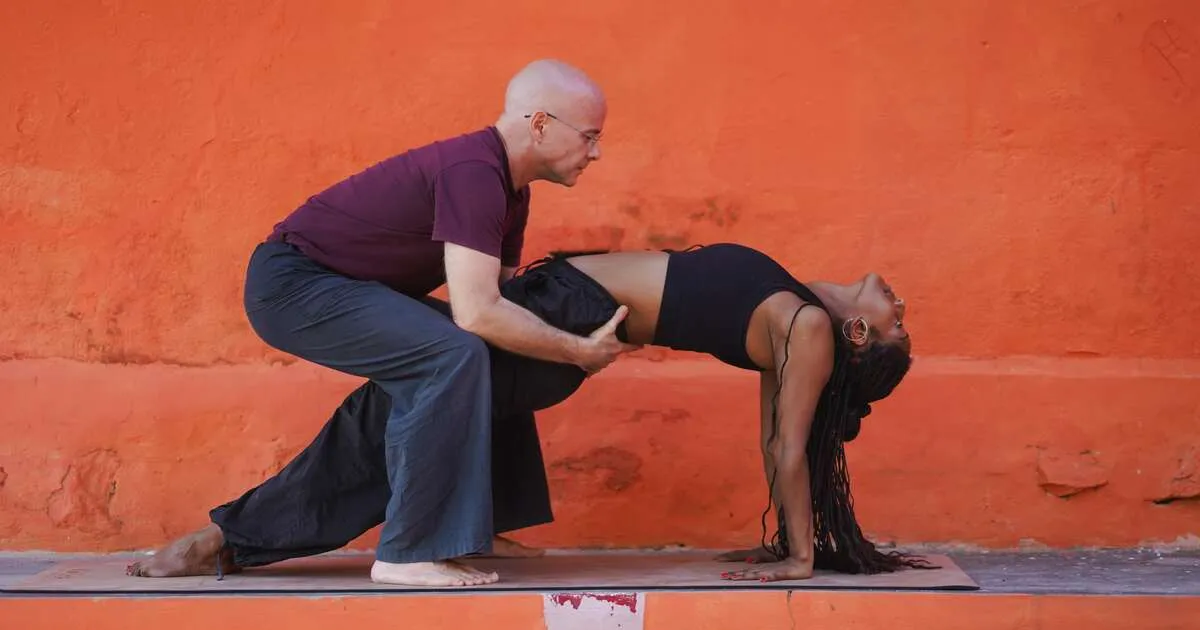
In Ashtanga the conditions are particularly favourable. The transmission passes through the body: the touch, the physical adjustment, the sequential progression that requires the teacher’s authorisation. That very brief moment in which someone adjusts you in a posture is not a neutral gesture: it involves an evaluation, sometimes an implicit authorisation to go further. The body registers all of this at a level deeper than intellectual understanding.
To this is added the structure of the lineage: you are not simply studying yoga, you are forming yourself in someone’s tradition. That sense of belonging becomes part of who you are, not only of how you move on the mat.
The result is a structural asymmetry: the student builds internally a representation of the teacher, attributing to him or her qualities, intentions, an emotional closeness that has never been verified in real experience. Like reading a personal message in the eyes of someone who is simply looking at everyone. The teacher, for his part, cannot reciprocate individually, it is not indifference, it is simply arithmetic. When students become hundreds, if not thousands, the relationship changes in nature even if on the surface it seems to change only in size.
And when many people share the same relationship with a figure, something further happens: belonging to the group of those who follow that teacher becomes itself a source of identity. It is no longer just about learning from X, but about being among those who follow X. With everything that entails.
World Didn’t Change, I Did
I continued to develop and share my practice, and I had the good karma of encountering more than knowledgeable teachers outside the mainstream. Since 2017 I have been studying with my main teacher.
I saw things changing around me with different eyes. For example, after the death of Sharath I observed several things happen.
The first season, Sharath passed away about a month before it began, most of his students who had already organised their time came to Mysore anyway. Many stayed in the shala to do self practice, without a teacher. Then the more senior students took turns assisting, initially in an unstructured way. The following year things began to take more defined shape: I was told that criteria are being developed for granting teaching authorisations, a structured curriculum. Before, everything was in the hands of Sharath alone, who decided who, how and why authorisations were given or taken away.
In that first season I met several people with a similar story: they had come to Mysore for the first time specifically to practise with Sharath, and had not made it in time. I remember in particular a woman who told me: “I came to meet my guru and I didn’t make it in time.” Guru: a word that in the Indian tradition carries an enormous weight, a deep spiritual bond that goes well beyond that with a simple teacher. Without ever having met him. I wonder whether it was already an asymmetric relationship, built at a distance.
In that same season the practitioners who were doing self practice in the shala paid the full fee. Some disagreed and left, not only for economic reasons: it was a deeper question about what they were looking for and where to look for it. Someone told me, and I agree: “they could have asked for just a donation, they probably would have received the same number of payments.”
It was as if a great tree had fallen. Now the light reached other plants that had not been touched by it before. Knowledgeable teachers had more space to make their way and grow.
I continued to observe the phenomenon in the communities I frequented. I saw groups of practitioners form with a strong collective identity, the “tribe”. I saw the number of students grow, first arithmetically and then geometrically, and with it the increasingly widespread need to feel seen individually by a teacher who inevitably had less and less space to do so. I encountered students who explicitly expressed that desire to me. I recognise it as a natural symptom of the parasocial relationship: as the number of students grows, so does the need to feel seen individually, and that space becomes inevitably harder to fill. I could see it happening in real time.
I asked myself what I would do if I found myself in that situation, with a constantly growing number of students. At the moment I have no answer.
There Is No Bad Guy In The Story
An important characteristic of this phenomenon is that it is not necessarily linked to the presence of malicious intent on the part of the teacher, nor to a group of people who are naive or incapable of offering constructive criticism of their own journey. In fact, perhaps a fundamental factor for this relational dynamic to develop, at least initially, is precisely the quality of the teacher. A mediocre teacher gets criticised. A good one gets protected.
The dynamic can emerge as a side effect of a relational structure that nobody designed. In concrete terms: the teacher receives signals that seem positive, nobody raises real objections, consensus appears unanimous. Not because anyone is orchestrating it, but because the group, without realising it, tends to filter out critical voices. That silence can easily be mistaken for genuine agreement, becoming in the perception of the one teaching proof of consensus.
One particularly insidious aspect is precisely this: there is no identifiable responsible party, and yet neither the student nor the teacher is necessarily seeing all aspects of the relationship for what it truly is.
Is It Negative?
The honest answer is: it depends on what is made of it.
Idealisation has a function. It opens a space of trust that makes deeper learning possible. Those who idealise their teacher often learn with more attention, more dedication, more openness to change. Expecting the teaching relationship to always be perfectly symmetrical and free of projections would be unrealistic, and would probably impoverish the very experience of the practice.
It becomes problematic when it becomes rigid, when it stops being a tool and becomes an end in itself. For the student, when identification with the figure replaces autonomous thought. For the teacher, when the following becomes a resource to manage rather than a responsibility to honour.
The question is not whether the phenomenon exists, it always does. The question is how we inhabit it.
How To Inhabit It, Awareness
Recognising the presence and structure of the phenomenon is the first step. It does not cancel the dynamics, but creates a distance that allows us to navigate them with greater clarity.
From the student’s side, the invitation is to develop over time a capacity for discrimination: to distinguish between enthusiasm grounded in a real encounter and what is internal construction, and between the teacher and the teaching, remembering that the former is a means to the latter.
In Yoga we speak of developing viveka, the capacity for discernment, to discriminate between what appears and what truly is. It rarely comes immediately: it refines over time, if the context favours it.
As students we have the responsibility to make the best possible use of our time with our teacher in order to develop our own practice.
From the teacher’s side, awareness requires something more difficult: giving up part of the power that the phenomenon offers. Not modulating the perceived closeness to keep the group cohesive. Actively seeking critical feedback rather than waiting for it. And above all creating the conditions for those who are learning to progressively develop autonomy, even at the cost of losing some followers along the way.
A good teacher, in this sense, should work to make himself unnecessary, in the same way that a parent will always be present for their child but hopes for their independence.
After all, the Buddha himself asked that his words not be accepted simply because he had said them, but wanted his disciples to verify them for themselves:
“O monks and learned ones,
Just as gold is burnt, cut and rubbed,
Examine my words carefully and
Do not accept them simply out of respect.“
Tattvasaṃgraha
There is also, in Tibetan Buddhism, a gesture that reminds us how the teacher is only a means, however fundamental, for the transmission of knowledge. Before transmitting Buddhist teachings, the master makes three prostrations. Not to the students, but to the Dharma, to the truth he is about to convey. It is a gesture that reminds everyone, the master included, that the teaching is greater than the one who transmits it.
At a collective level, perhaps the most concrete risk: a community that cannot question its central figure has already stopped, in some measure, learning from it. The group closes, dissent becomes costly, belonging transforms into identity. It is no longer just a relationship with a teacher, it is a shared and dogmatic vision of the world that admits no cracks.
Creating the conditions for dissent to be possible is not a formal exercise, but a practice that requires constant intention, on everyone’s part.
Back To The Coffee
That conversation in an Indian bakery, coffee in hand, made me realise I was witnessing something I had already encountered. I had seen it in the queue at 4 in the morning outside the shala. I had heard it in the conversations about what Sharath had communicated with a glance. I had read it in the message of a woman who had come to Mysore to meet her guru without ever having met him. I could see it emerging in the communities around me.
I was not judging anyone. I was recognising a structure.
That person at the coffee was not doing anything wrong. He was living something real, something many of us have lived or are living. The question is not whether the phenomenon exists, it always does, around anyone who teaches with dedication and quality. The question is whether we inhabit it with awareness or not.
I keep asking myself that question. Even about myself, as a teacher.
Final Note
This is one aspect of a practice that is far more articulated than it often appears. Ashtanga Vinyasa Yoga, let us not forget, is Ashtanga Yoga, and it is Yoga, not just a series of postures to photograph for Instagram.
For those who would like to explore the parasocial relationship beyond what we have covered here, I have developed a more extensive reflection, you can download the PDF here link
Buona pratica
Om Shanti