

Before playing that song, the guitarist would pause to adjust the tuning pegs on the headstock of his guitar. Just a few seconds, no more. The first time I saw him doing it, I assumed the instrument had gone out of tune. But that could not be the case every time, especially just before the same piece. He explained that he was changing the tuning to suit the song he was about to play.
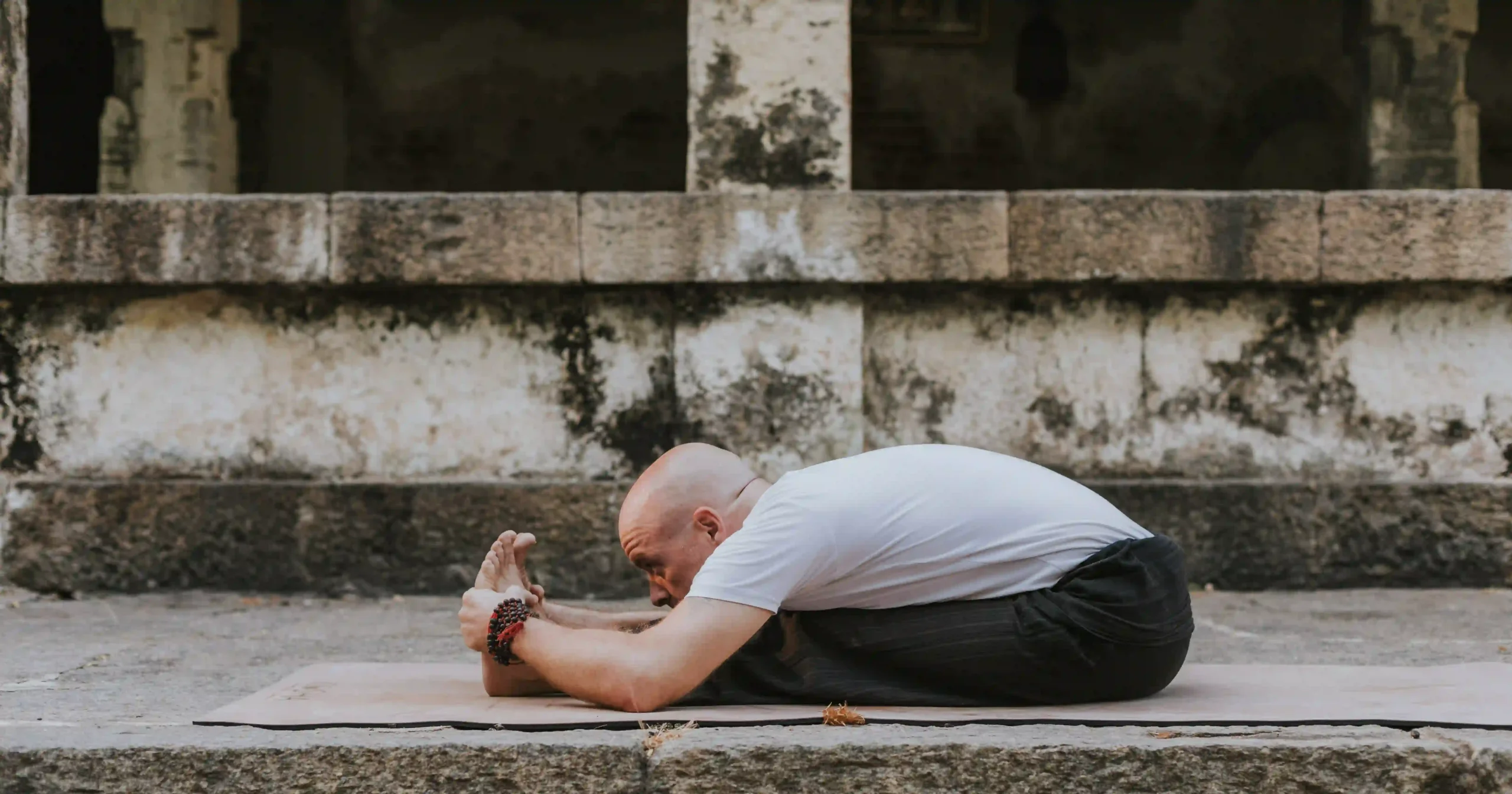
This memory from my days as a drummer in a band – so many years ago that it feels like one of my previous lives – came back to me during a class when I noticed a practitioner subtly pointing her foot in paschimottanasana. This forward bend is intended to lengthen the posterior chain of the legs and is usually practised with the feet flexed, the knees straight, while exploring the relationship between the muscles of the lower back and the hamstrings.
The change in foot position, combined with a slight release of the knee, allowed her to reduce tension on the tendons at the attachment point of the hamstrings – where the muscles at the back of the thigh connect to the pelvis, hence the colloquial yoga butt. A very common injury caused by over-stretching the hamstring, which can often linger for months.
Without realising it, the student was retuning her body in order to play the piece correctly. When I approached her and drew her attention to her foot, she replied yes, almost in a whisper, as if justifying herself. We worked together, reviewing several aspects of her practice, adjusting alignment and the intentions carried into the postures that may have contributed to the problem in the first place, and that could have prevented a prompt recovery.
Yoga butt often affects flexible practitioners, and is just as often mistakenly considered negligible, leading to continued forcing of movement and disregard for the dull pain coming from the gluteal region. Some practitioners override the body’s signals in order to achieve a front split that appears to be “so important.”
Yoga butt is an extreme case, but retuning is not only necessary when something breaks. It is needed every day – and that is the point.
Daily practice is a moment of listening. Not in the generic sense in which this is often used, but in a technical sense: checking every day where you are, how you are, and what that particular day brings with it. The tuning is subtle and constantly shifting – yesterday’s body is not today’s body, and the mind even less so. What is learned on the mat does not stay on the mat.
And there is one final illusion to avoid: from the outside, an Ashtanga practice always appears the same – the same sequences, the same postures, in the same order. But it is never the same practice. The intentions change, the alignment you bring with you changes, what you express changes. And it is precisely there, in that invisible difference from the outside, that the whole work lies.
Buona pratica
Om shanti

Pingback: How to Practice Asana Correctly - ashtangamarga.com