

Ashtanga is not just asana, even though there is no denying that the daily practice on the mat is a fundamental part of it: much like saying that you are not just your body, but try living without it. So it is worth stopping for a moment and asking yourself: what does it mean to practice asana correctly? Let’s find out by exclusion. There are two ways of practicing asana incorrectly: too much and too little.
To understand this better, let’s think about how medicines work. Have you ever taken an antibiotic? In order for it to work within its effective range, you have to take it according to a dosage: a certain number of pills for a certain number of days. Let’s imagine that the doctor tells you to take two pills a day for five days. If you decide to take the pills for only three days, or to continue the treatment beyond five days, you are making the medicine work outside its therapeutic window: in the first case it is not effective, and in the second you are intoxicating yourself.
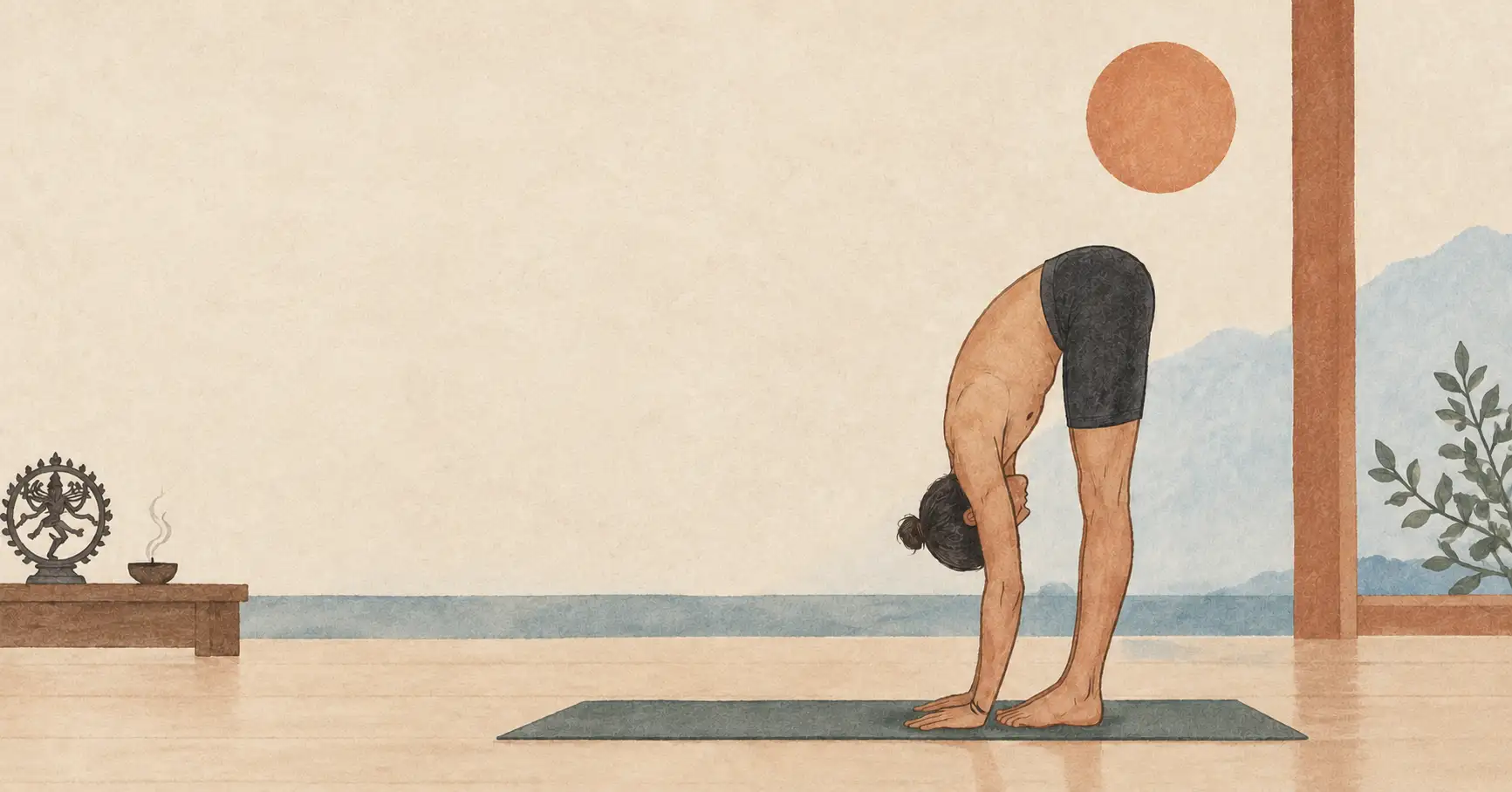
f you think about it, this same principle applies to all the things that have the potential to bring about changes in your body, and not only your body: the food you eat, the number of episodes of your favourite series you watch in a row, and, getting back to what we are talking about, asanas. Practicing asana is good for you, but only if it happens within the effective range of your practice. Okay, here we are. The question is: what is the effective range of your practice? A good starting point is to turn to Patanjali, who wrote in a single verse of the Yoga Sutras that “the posture should be steady and comfortable” (sthira-sukham-āsanam, sutra 46 of the Sadhana Pada). Every day, as you step onto your mat, you try to awaken your body and bring it to work at the fullest expression of what it can do that day. Not listening to your body and deciding to do a forward bend with the expectation of bringing your chin to your shins on a day when your body does not allow it, pulling on the hamstrings and pushing your chin down, perhaps even rounding your spine: this is asana intoxication, you are following the dosage for an injury. Conversely, if you do not take the postures all the way, if you keep your elbows bent in utkatasana, or your front leg too high in virabhadrasana II, then you are working below the effective range: you are not hurting yourself, but it serves little or no purpose. And to be clear, I am not talking about modifying an asana because you need to in that particular moment, but about habitually half-doing them without any reason, without even being aware of it.
Practicing within your effective range means one thing above all: you have to be present in your practice, and that in itself is the complete recipe for a correct practice, in which asanas become a tool for listening to yourself in the laboratory of the shala. This approach is one of the reasons why I believe that the Mysore style of yoga practice, when the practitioner follows the rhythm of their own breath, is the only way to practice asana rather than just gymnastics (without taking anything away from gymnastics).
Some time ago, during a class, I heard a practitioner whisper to herself in Prasarita C, “it hurts more than usual,” referring to her shoulder. We clarified that it was not “pain or hurting”, but an intensity associated with reaching the working zone at the limit of the range of movement – and, of course, we reviewed the alignment so that she could perform the posture safely: in her case, placing the emphasis on the hamstrings and the posterior chain. I invited her to continue her practice while listening to her body and looking for three words to define three stages she would encounter: one involving movement below the effective range, one within the effective range, and one when she felt she was going beyond the limit of the effective range, which should be the point at which she would “feel pain”, and which should not be reached. I found this exercise useful for focusing on listening to the present moment, because being aware of your practice is not optional, it is the practice.
So, how do you practice correctly? The right amount.
Learn to recognize the three levels – too much, too little, adequate – and you will have a concrete tool to guide your practice.
And you? What three words would you use for these stages of your practice? Are you aware of them?
Buona pratica
Om shanti


Subscribe to the Newsletter
Workshops, updates from the shala, reflections on practice. I write when I have something to say.
Newsletter Subscription Confirmed
Namasté,
thank you for subscribing.
You'll receive essential updates on Ashtanga Yoga practice, study, and events.
Have a good day and happy practicing!
See you soon
Alan