

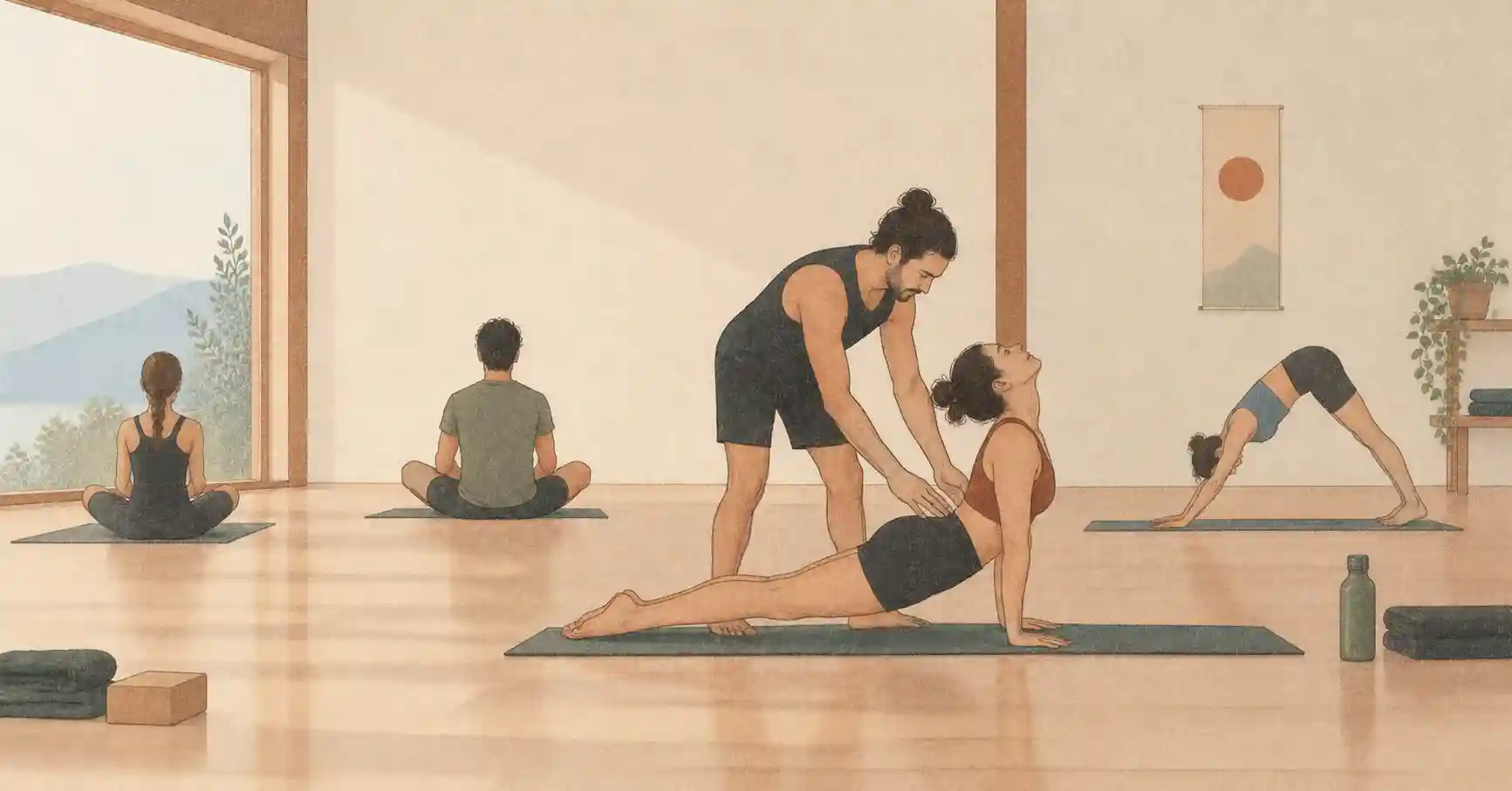
Well, yes and no. It might sound like an evasive answer, but Ashtanga is a journey, and different stages of that journey come with different needs, not to mention our distinct individual dispositions.
To explain what I mean, let’s look separately at two aspects of practicing alone or in a shala: the teacher and the community of practitioners.
The Ashtanga Teacher
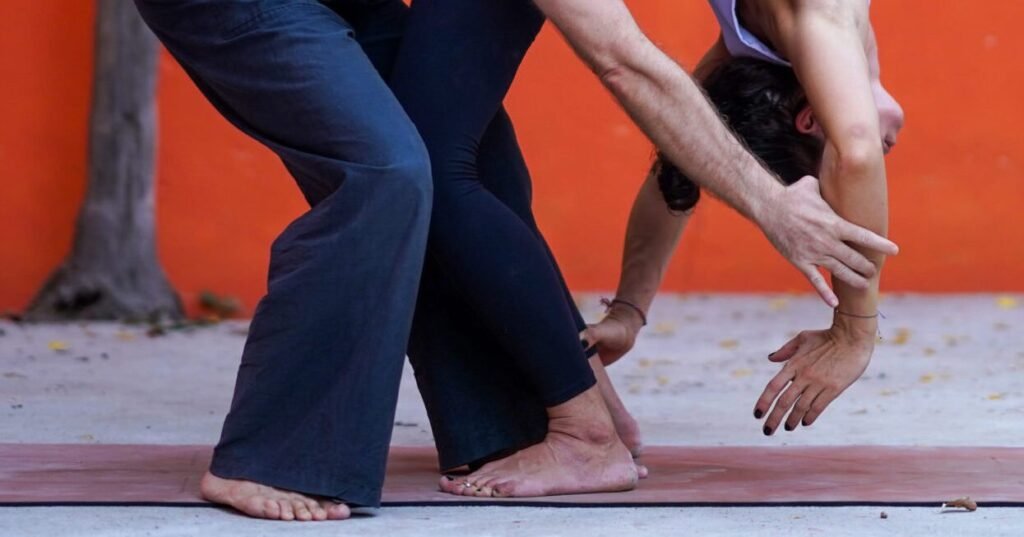
Yes, you need a shala to practice Ashtanga Yoga, because you need a teacher. To learn something, you need a source of information. In Ashtanga Yoga, books and videos can be useful, but they cannot replace a teacher who practices sincerely and embodies the principles of the discipline. Ashtanga should be taught in person; the practice must be adapted to each practitioner’s uniqueness. This is one of the paradoxes of Ashtanga: beginners, who need to modify the practice, don’t know how to do so; experienced practitioners, who may no longer need to, know how.
In my own journey, I first learned from several teachers before settling into the same shala in Mysore for over ten years.
No, you don’t need a shala to practice Ashtanga Yoga, because having a teacher doesn’t mean you have to be by their side every day. At the beginning, you need to learn, and you don’t yet have the tools to evaluate what you’re being taught. Over time, through practice and experience, you develop discernment and become more independent. You may eventually meet your teacher only periodically, once a week or even once a year, without giving up your relationship with them or compromising your practice.
Once you’ve grown your wings, it’s only right to start flying. Your practice can take root in your teacher’s guidance, but it must find its expression through you: there needs to be a degree of separation between you and your teacher. Also, in case you want to become a teacher yourself, you must first have your own practice. In my view, a good way to approach your relationship with your teacher is to learn how to make good use of the time you spend together.
If you’d like to explore the teacher-student relationship further, I discuss it in my article on parasocial relationships in Ashtanga Yoga.
The Ashtanga Community
Now let’s consider the second element: the community of practitioners at a shala.
Yes, you need a shala to practice Ashtanga Yoga, because you need a group of people with whom to share your practice, both on and off the mat. Ashtanga requires a certain degree of dedication, and sharing this experience can help during difficult times. If you step onto your mat every morning, you know that at some point you had to make a choice: “Either I stay up late in the evening or I get up early in the morning.” There is no middle ground that can be sustained for long, and there aren’t many “early-morning warriors,” especially in the West. In winter, when it’s cold and still dark outside, leaving the warmth of your bed while the rest of the world sleeps isn’t always easy. In short, within the Ashtanga community — and here I’m extending the concept beyond a single shala — you can find understanding, support, friendship, and like-minded companions along the way.
No, you don’t need a shala to practice Ashtanga Yoga, because the group at a shala can distract you and disrupt the concentration you’ve developed during your practice. Sometimes, post-practice chatter starts in the changing room (with endorphins playing their part), grows loud and excessive, and continues just outside the door, where selfies appear, ready to be posted with the caption “post-practice glowing.” What’s more, within the Ashtanga community — and here, too, I’m extending the concept beyond a single shala — you can encounter competition, envy, and jealousy.
In Conclusion
Practice is personal and inward, but having a teacher is important for developing it, and a community can be helpful. Their importance varies from person to person and over time. Learning to practice on your own is part of this journey and is essential if you want to become a teacher. I see no contradiction between practicing at a shala and practicing alone: they are two ways of experiencing the practice that can coexist. When I practice, whether at a shala in Mysore or on my own, I focus on my breath. It also helps that I can’t see very well without my glasses.
Buona pratica
Om shanti

Subscribe to the Newsletter
Workshops, updates from the shala, reflections on practice. I write when I have something to say.
Newsletter Subscription Confirmed
Namasté,
thank you for subscribing.
You'll receive essential updates on Ashtanga Yoga practice, study, and events.
Have a good day and happy practicing!
See you soon
Alan